|
Systems Ecology and Resource Management Écologie des Systèmes et Gestion des Ressources - Biocomplexity Research Focus - |
|||||||||||
|
|||||||||||
|
|||||||||||
![]() |
Research : The Laboratory of Systems Ecology and Resource Management (c/o Prof. Farid Dahdouh-Guebas), seeks to understand and to predict how and why spatio-temporal dynamics in vegetation and landscape occur. |
||||||||||
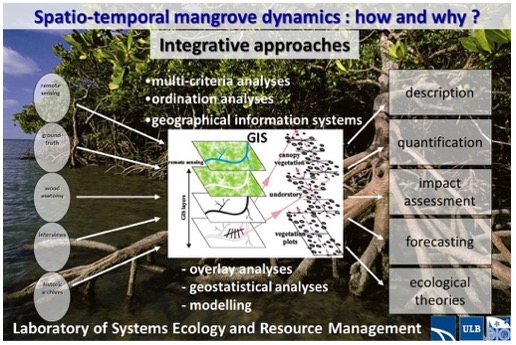
| It adopts a retrospective approach using relevant methods
from different disciplines (tropical botany, very high resolution sequential
remote sensing and ground truth, socio-economic survey research, historic
archive research,...), an integrative analysis (using geographical
information systems, multivariate and multicriteria analyses,...) in order
to generate outputs relevant for fundamental understanding of ecosystem
functioning (health status, resilience) and for its management
(conservation, restoration). Within this framework we also emphasize
biodiversity changes, climate change, ecological and ethological
plant-animal interactions and man-ecosystem interactions. Mangrove forests
form an important model for our research, but close links exist with
adjacent ecosystems such as tropical rainforests or coral reefs. The
research is done on different spatial scales from the case-study level in
different countries to the macroecological level (global).
The research is often done in collaboration with the Laboratory of Plant Biology and Nature Management of the Vrije Universiteit Brussel (Prof. Nico Koedam). This lab is the continuation of the Laboratory of Systematic Botany and Phytosociology (Prof. Jean Lejoly - ULB) and was initially called Laboratory of Complexity and Dynamics of Tropical Systems. |
|||||||||||
| Le
Laboratoire d'Écologie des Systèmes
et Gestion des Ressources (dirigé par le
Prof. Farid Dahdouh-Guebas),
tâche de comprendre et de prédire comment et pourquoi la dynamique
spatio-temporelle dans les écosystèmes végétaux existe. On utilise une
démarche rétrospective avec des méthodes appropriées de différents
disciplines (botanique tropicale, télédétection et contrôle sur le terrain
séquentiel à très haute résolution, des enquêtes socio-écologiques, la
recherche archivistique historique,...), une analyse intégrative (utilisant
des systèmes d'information géographiques, analyses multivariables et
multicritères,...) pour générer ainsi des résultats qui sont pertinent pour
la compréhension fondamentale du fonctionnement de l'écosystème (état de
santé, résilience) et pour sa gestion (préservation, options de
restauration). Dans ce cadre il y a également un appoint sur les effets d’un
changement de la biodiversité, du climat global sur les interactions
plante-animal et homme-écosystème. La mangrove est un modèle important, mais
des liens très proches avec les écosystèmes voisins, comme la forêt
tropicale ou le récif corallien, sont également envisagés. Les études sont
faites sur différentes échelles spatiales de l’étude de cas local dans
plusieurs pays tropicaux jusqu’au niveau macroécologique (global). La recherche est souvent effectuée en collaboration avec le Laboratoire de Botanique et de Gestion Naturelle de la Vrije Universiteit Brussel (Prof. Nico Koedam). Le laboratoire est la continuation du Laboratoire de Botanique Systématique et de Phytosociologie (Prof. Jean Lejoly - ULB) et était initialement nommé le Laboratoire de Complexité et Dynamique des Systèmes Tropicaux. |
|||||||||||
|
Model ecosystem and geographical sites :
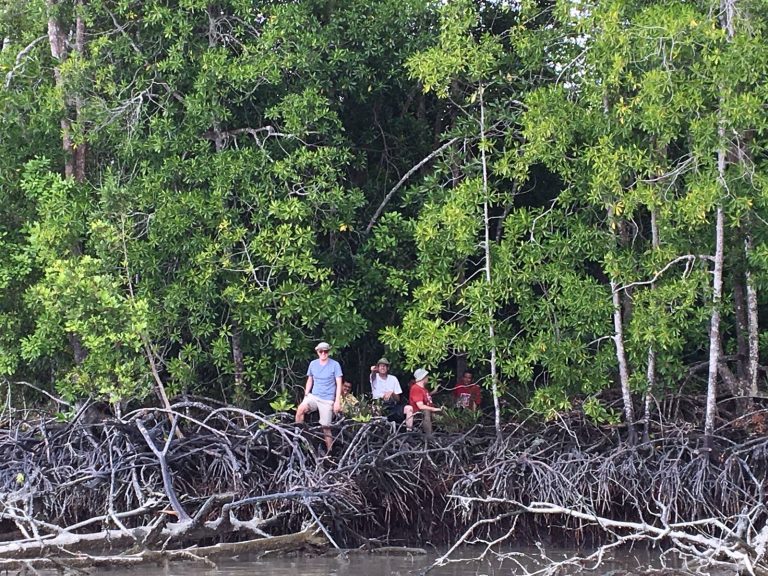
Mangrove forests form the primary model ecosystem the unit studies, and studies were carried out in the following countries :
|
|||||||||||
|
|||||||||||
|
|||||||||||
| Head of the research unit / Promoter / Co-Promoter : | Prof. Dr. Farid DAHDOUH-GUEBAS |
![]() |
||||||
| Staff : |
* registered at another university or research institution in Belgium or abroad 1 MSc. Biologie des Organismes et Ecologie (Finalité approfondie), ULB 2 Master International en Biodiversité et Evironnements Végétaux Tropicaux - BEVT, ULB 3 Erasmus Mundus Masters Course in Tropical Biodiversity and Ecosystems - TROPIMUNDO, ULB-VUB-UPMC-MNHN-UNIFI-UCP-UDsch-UQ 4 MSc. en Bioingénieur, ULB 5 MSc. en Sciences Géographiques, ULB 6 MSc. en Sciences et Gestion de l'Environnement, ULB 7 Master en Sciences et Gestion du Tourisme, ULB 8 Master en Information et Communication, ULB 9 MSc. in Biology, VUB 10 Master in Marine and Lacustrine Science and Management - Oceans & Lakes, VUB-UGent-UA 11 MSc. in Human Ecology, VUB |
|||||||
|
Alumni : |
The students who finalised their thesis or postdoc under (Co-)Promotership of Farid Dahdouh-Guebas are listed here. |
|||||||
| Publications : | ||||||||
| Education : |
|
|||||||
|
||||||||
|
||||||||
|
||||||||
|
||||||||
|
||||||||
|
||||||||
| In the media... | Media coverage, newspaper articles, electronic articles, etc. can be found here | |||||||
Contact :
|
Prof. Dr. Farid DAHDOUH-GUEBAS Département de Biologie des Organismes Ecologie des Systèmes et Gestion des Ressources Systems Ecology and Resource Management Université Libre de Bruxelles - ULB Campus de la Plaine Avenue Franklin D. Roosevelt 50, CPI 264/1 B-1050 Bruxelles Belgique - Belgium Tel. +32 (0)2 650 xx xx (bureau O3.204) Fax. +32 (0)2 650 xx xx E-mail : fdahdouh@ulb.ac.be |
![]() |
See also collaboration with : Laboratory of Plant Biology and Nature Management (Vrije Universiteit Brussel - VUB)
See also : Herbarium of the Université Libre de Bruxelles (BRLU)